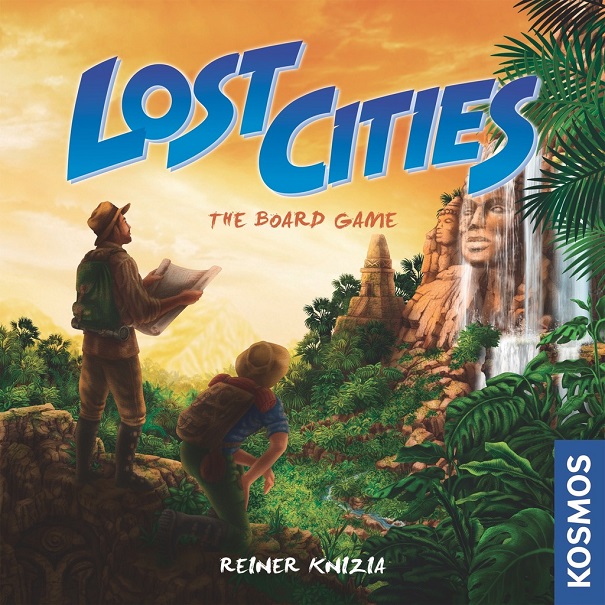
Lost Cities Review
The Two-Player Card Game That Rewards Commitment
Hook / First Impression
Lost Cities does something few card games manage: it forces you to commit. The moment you play the first card of an expedition, you have invested 20 points — a wager that must be repaid through the cards that follow. Play too early and you bleed points. Hold too long and your opponent seizes the cards you need. In twenty minutes, it produces more genuine tension than many games twice its length.
Reiner Knizia designed it in 1999, and it has aged with the confidence of a game that knew exactly what it was from the start. It remains one of the most-recommended two-player introductions to modern board gaming — a pocket-sized, portable, elegantly brutal little card game that couples and competitive pairs keep returning to game after game.
Overview
Lost Cities is a two-player hand-management and set-collection card game designed by Reiner Knizia and published by KOSMOS in 1999. Players lead competing archaeological expeditions across five ancient sites, building ascending sequences of numbered cards and managing the risk of whether to commit to each expedition at all.
| At a glance | |
|---|---|
| Designer | Reiner Knizia |
| Publisher | KOSMOS / Thames & Kosmos |
| Year | 1999 |
| Players | 2 |
| Play time | 20–30 minutes |
| Age | 10+ |
| Weight | Light (BGG ~1.7/5) |
| Victory condition | Highest total score across all three rounds |
Components & The Setting
The Setting: You and your opponent are rival archaeologists launching expeditions to five lost civilisations — a Himalayan mountain range, a rainforest, a desert, a volcanic island, and an underwater ruin. The theme is atmospheric enough to give flavour without demanding narrative investment. The card art depicts the destinations with a pleasingly retro illustrated style, and the coloured suit system — yellow, white, blue, green, red — maps naturally to the five locations. The theme is thin but consistent; it earns its place.
The component set is modest by design. You get 60 cards — twelve per suit — divided into nine numbered cards (values 2–10) and three wager cards per colour. A central game board provides columns for each expedition's discard pile, acting as the shared tableau between players. Cards are standard poker-sized with clear numbering and bold colour coding.
The box is extremely compact — roughly the size of a thick paperback novel. This is a game that travels. It fits in a jacket pocket, comes out on trains and planes, and sets up on a café table in under a minute. The components do not aspire to luxury, but they are fully functional and durable. At its price point, nothing is missing and nothing is wasted.
How to Play
The goal is to score more total points than your opponent across three rounds. Points are scored by building ascending numbered sequences in each colour — but each expedition you start costs 20 points before any cards are counted. The player who commits wisely and builds efficiently wins.
On your turn, you take exactly two actions in order:
- Play or discard a card. You must play one card from your hand — either face-up to your own expedition row (committing to that colour) or face-up to the corresponding colour's discard pile on the central board (removing it from play but making it available to your opponent).
- Draw a card. You draw either from the top of the face-down draw deck, or from the top of any one of the five discard piles on the central board.
Expeditions score as follows: sum all the numbered cards you played in a colour, then subtract 20 points. An expedition with a sum of cards totalling less than 20 scores negative points — you lose the difference. An expedition totalling exactly 20 scores zero. An expedition with eight or more cards earns a flat +20 bonus regardless of the sum.
Wager cards multiply the expedition's net score (after subtracting 20). One wager doubles it; two wagering cards triple it; three wagering cards quadruple it. Wager cards must be played before any numbered card in that colour, and they apply to both positive and negative results — a doubled losing expedition hurts twice as much.
The round ends immediately when the draw deck is exhausted. Players score all their expeditions, record totals, reshuffle, and play a second and third round. The player with the highest combined three-round score wins.
Gameplay Feel
Pacing & Tension: Lost Cities plays fast — typically 20–25 minutes — but the tension is front-loaded and then escalates sharply toward the endgame. Early turns feel exploratory: drawing cards, evaluating hand potential, watching the discard piles for information. The middle game grows tighter as expeditions commit and both players begin shaping their engines. The final third of the deck produces near-constant anguish: every draw could be the card that rescues a losing expedition or the card you desperately need that goes to your opponent instead.
Player Interaction: Interaction is indirect but pointed. The discard piles are shared information — and shared temptation. Discarding a card feeds your opponent's potential hand; drawing from a discard pile denies it from them. The game is relentlessly zero-sum in a way that feels personal without being aggressive. You will watch your opponent draw exactly the card you needed from the pile you just contributed to, and it will sting in the best possible way.
Luck vs. Strategy Balance: Lost Cities has more variance than its depth might suggest. Card draw is genuinely random and specific hands can be harder to work with than others. Over a single round, luck plays a meaningful role — a hand dealt three cards of the same low colour may force a difficult choice regardless of skill. Across three rounds, skill consistently dominates: better hand management, smarter discard reading, and sharper wager timing will win the session even when individual rounds feel unfair. The three-round format is not arbitrary — it is a variance buffer.
Rule Overhead: Minimal to the point of elegance. The full rules teach in five minutes. The only concept requiring explanation is the wager card timing constraint — wagering cards must be played before any numbered card in that colour. Once understood, the rules never come up again. Lost Cities is one of the cleanest teach-to-play ratios in the hobby.
Mechanics Deep-Dive
The 20-Point Commitment
The expedition cost of 20 points is Lost Cities' masterstroke. It transforms every decision from a simple "play or don't play" into a risk-reward wager. An expedition with three cards totalling 18 points scores −2 — the commitment fee exceeded the return. The same three cards, plus a fourth totalling only 5 more points, score +3. The difference between a losing and a winning expedition is often a single card, and that card may be in the draw pile, in your opponent's hand, or already discarded.
This structure forces players to continually project forward: can I realistically get enough cards in this colour to recover the 20-point cost? The answer changes as the deck depletes, as discards accumulate, and as your opponent's row reveals what colours they are hoarding. The best players are constantly updating their expected value for each unstarted expedition based on visible information.
Wager Cards: Leverage and Danger
Wager cards are the game's most dangerous element. Playing one doubles the expedition's net score — but that net score can be deeply negative. A single wager on an expedition that ends at −10 yields −20. Two wagers on the same expedition yields −30. This leverage makes early wager plays high-stakes declarations: you are betting that you will collect enough cards to justify the commitment multiplied. Against an experienced opponent who knows which cards remain, the wager decision becomes one of the richest puzzles in the game.
- Wager timing: Wagering cards must precede numbered cards — so if you drew a wager in the mid-game after already playing a number, it must be discarded. This creates difficult hand management moments where a wager in hand is technically dead weight in certain colours.
- Opponent information: Playing wagering cards reveals your confidence in a colour. Experienced players watch for wagered expeditions and target the discards accordingly — starving a doubled expedition of its necessary cards is a genuine strategic line.
- The eight-card bonus: An expedition with eight or more cards earns +20 regardless of the card sum. This bonus changes the calculus for near-complete expeditions dramatically — five cards totalling 30 points scores +10, but adding three low cards to reach eight total adds +20 to the base even if the three cards contribute nothing useful.
Player Count Analysis
2 Players — The only option, and it's excellent. Lost Cities is designed exclusively for two. There is no variant, expansion, or fan rule that meaningfully extends it to three or more players without fundamentally breaking its balance. The discard pile mechanic — five shared piles between exactly two players — requires the bilateral tension of a two-player contest. With three players, piles would become anarchic and the information-reading layer would collapse.
Within the two-player frame, the game excels at almost every pairing: couples, competitive friends, quick head-to-head sessions between heavier games. It is one of the finest two-player card games ever designed. If you regularly play with more than two people, this is not your game — and that limitation is absolute, not a work-around.
Replayability
Lost Cities is a 60-card game with a shuffled deck — every round deals a different hand and produces different discard pile dynamics. The strategic space, while narrow compared to heavier designs, has surprising depth within its constraints: hand read accuracy, wager timing, discard pile denial, and round-to-round score management all reward dedicated practice.
The three-round structure within each session creates meaningful narrative arc — a player who lost round one badly knows exactly how much they need to recover and adjusts their risk tolerance accordingly. That session-level strategic layer keeps repeat plays interesting even when individual rounds feel familiar.
The honest ceiling: over dozens of sessions, the game's full strategic space becomes well-understood and some matchups can begin to feel formulaic. The Lost Cities: The Board Game variant (a separate product with a physical board) addresses this by adding path choices between expedition sites, though it targets a slightly different experience. For most regular two-player pairs, the base game sustains 50–100 sessions before the novelty fully exhausts. That is excellent value for its size and price.
Learning Curve
Ease of teaching: Exceptional. The rules fit on a single folded sheet. New players are fully playing by their second or third turn, with the ascending-sequence constraint and wager-before-number rules as the only friction points — both absorb naturally during the first round. Setup is under a minute.
First-game experience: Mixed in an instructive way. New players almost always start too many expeditions too early, commit to colours with insufficient backing, and score badly in round one. This is not frustrating — it is informative. The scoring feedback is immediate: a −14 expedition is a vivid lesson that lands without explanation. Most new players emerge from their first session wanting to play again immediately, specifically to apply what they just learned.
Who It's For
Couples and partners: Lost Cities is frequently cited as one of the definitive couples' games — fast enough to play before bed, deep enough to spark genuine competition, and short enough that the loser immediately wants a rematch. The three-round structure naturally produces sessions of 45–60 minutes without any commitment to staying at the table. It is, in practice, a two-player card game that plays like a best-of-three sporting contest.
Players new to the hobby: The minimal rules and compact session length make it a perfect introduction to the concept of hand management and risk assessment. Unlike heavier games, feedback from each decision is near-immediate — you see the consequences of a risky wager or a premature expedition within three or four turns, not at game end.
Travellers: The box fits in a jacket pocket and sets up on any surface with enough room for two hands of cards. It is one of the best portable games in the hobby and requires no explanation beyond a quick setup. On trains, planes, and café tables, it is genuinely ideal.
Experienced hobbyists: Lost Cities occupies the fast, portable, head-to-head slot that heavier collections rarely fill well. Its depth is real but bounded — most experienced players enjoy it as a palate cleanser rather than a centrepiece. If you play a lot of heavy two-player games (Twilight Struggle, 7 Wonders Duel), Lost Cities earns a place as the 25-minute opener or closer rather than the main event.
Comparisons: Jaipur covers similar two-player territory with a goods-trading mechanism and marginally more complexity. Patchwork has the same portable, couples-game reputation with a puzzle-piece spatial mechanic instead. Hive is more abstract and confrontational. Lost Cities is the sharpest and most anxiety-producing of the tier — no other two-player card game at this weight makes you feel the consequences of your decisions quite as immediately.
Pros & Cons
What Lost Cities does well:
- Teaches in five minutes and produces genuine strategic tension from the very first turn.
- The commitment mechanic — the 20-point expedition cost — is one of the most elegant risk-reward mechanisms in the hobby, producing difficult decisions from a minimal ruleset.
- Extremely portable: the compact box fits a jacket pocket and sets up anywhere in under a minute.
- The three-round structure smooths variance and rewards strategic adjustment across the session.
- Exceptional replay value relative to its price and size — a session of three rounds fits in 30 minutes and sustains interest across many sessions.
- No player elimination, no downtime, no waiting — every turn is fast and consequential.
Where Lost Cities struggles:
- Strictly two players — there is no path to three or more without a fundamentally different game.
- Variance in a single round can feel punishing: a hand with almost no useful cards in your committed colours genuinely limits your options regardless of skill.
- The base version has five colours; the newer edition adds a sixth (white). The sixth colour adds rounds that run slightly longer and a bit more complexity — verify which edition you are buying if you have a preference.
- The theme, while flavourful, does not connect meaningfully to the mechanics. Players hoping for exploration narrative will find a clean abstract system with adventure art, not a story.
- Experienced players will find the strategic ceiling relatively accessible within 30–50 sessions, after which the game's outcome depends more on variance management than discovery of new lines.
Expansions & Ecosystem
Lost Cities has remained essentially unchanged since 1999 — a mark of design confidence rather than neglect. KOSMOS has released two meaningful variants rather than traditional expansions:
1. Lost Cities: The Board Game — Multiplayer adaptation for 2–4 ★★★☆☆
A separate product that adapts the card game's core scoring into a board-based format with path choices between expedition sites. Players compete for the same expedition routes, adding a spatial layer the card game lacks. It handles 2–4 players and plays in 60–90 minutes. The board game extends the original's reach to larger groups but loses the tight bilateral tension that makes the card game special. Recommended only if you specifically want a multiplayer Lost Cities experience — most players who love the card game prefer it to this adaptation.
2. Lost Cities: Rivals — Card drafting variant for 2–4 ★★★★☆
A draft-based variant using the same expedition-scoring system, where players select cards from a face-up market rather than drawing from a shared deck. The drafting layer adds direct card denial absent from the base game and scales to four players cleanly. Players who exhaust the base game or want a multiplayer version consistently prefer Rivals to The Board Game. Not a replacement for the original — a well-designed companion.
Quick Buyer's Guide
| Game | Best For | Complexity | Rating | Priority |
|---|---|---|---|---|
| Lost Cities (base) | Two-player couples, travellers, new hobbyists | Very low | ★★★★☆ | 🥇 Start here |
| Lost Cities: Rivals | Groups wanting multiplayer + card denial | Low | ★★★★☆ | Good follow-up for 3–4 players |
| Lost Cities: The Board Game | Fans who specifically want a board version | Low-Med | ★★★☆☆ | Skip unless you need multiplayer |
Value for Money
Lost Cities retails for approximately $20–$25 USD (€18–22 in Europe). For a 60-card game in a compact box, it is priced appropriately — not cheap for what you physically receive, but fair for what you actually experience. The per-session cost over a regular two-player pairing is negligible within a few months of ownership.
Used copies are widely available and typically in excellent condition — the cards see light handling and the box is nearly indestructible. A used copy at $10–12 is functionally identical to a new one. It is genuinely one of the best-value two-player games available regardless of edition.
- Gift for a couple: An excellent choice, especially paired with a second two-player game like Jaipur or Patchwork. It is approachable enough to enjoy immediately and deep enough to stay in rotation.
- Traveller's game: Best-in-class for the size-to-quality ratio. No other game at this price fits this many interesting decisions into this small a package.
- Already own a large collection: Worth adding as the 20-minute, zero-setup two-player option that complements heavier games rather than competing with them.
Accessibility
Color differentiation: Lost Cities relies heavily on colour to distinguish the five expedition suits. Each suit is identified primarily by card colour with a secondary expedition symbol — a helpful redundant cue. Red-green colour blindness may cause difficulty distinguishing the red and green suits under some lighting conditions. Players with colour vision differences are advised to verify suit recognition using the expedition symbols (available on every card) before purchasing.
Language dependence: None. The cards contain only numbers and wager symbols — no text appears in gameplay. The game is fully playable without reading any language.
Cognitive accessibility: Well-suited to a wide range of profiles. The rules are brief, the turn structure is fixed (play one, draw one), and all information except the draw deck is face-up and transparent. Players who struggle with long rule sets or complex decision trees will find Lost Cities manageable from game one. The main cognitive demand is tracking which cards have been played and what remains available — this is optional complexity; casual players can ignore it entirely and still have a satisfying experience.
Physical accessibility: Standard poker-sized cards, easily held in one hand. Players typically hold 8 cards at a time. The small footprint of the playing area — two rows of five piles on a small central board — is easily managed on any table surface. Minimal dexterity required.
Age range: The 10+ rating is appropriate. The subtraction in scoring (sum minus 20) requires basic arithmetic comfort, and the risk assessment involved is more intuitive for players with some game experience. Children aged 8–9 can participate with guidance on the scoring calculation.
Verdict
Lost Cities is a masterpiece of constraint. Reiner Knizia distilled the essence of risk management into 60 cards, five colours, and a single brilliant scoring rule — the 20-point expedition cost that makes every commitment feel meaningful and every misplay feel instructive. In twenty-five years since its release, no two-player card game at this weight has surpassed it for elegance, portability, or the specific quality of anxious, satisfying decision-making it produces every single turn.
Its limitations are clear and honest. It plays exactly two. A single bad round can feel variance-driven in ways that are temporarily frustrating. And experienced players will eventually understand its full strategic space. None of these represent failure — they are the costs of a design that prioritised sharpness over scope.
Buy it if: you regularly play games with one other person and want a fast, portable, deeply satisfying card game that produces genuine tension every session.
Skip it if: your game nights are typically three or more people — the game does not scale and there is no meaningful workaround.
Pair it with: 7 Wonders Duel for longer two-player sessions, or Splendor for when a third player joins the table.
Score Breakdown
Love board game night? Explore our tools, score calculators, and strategy guides — everything you need to play better and have more fun.
Browse All Articles →