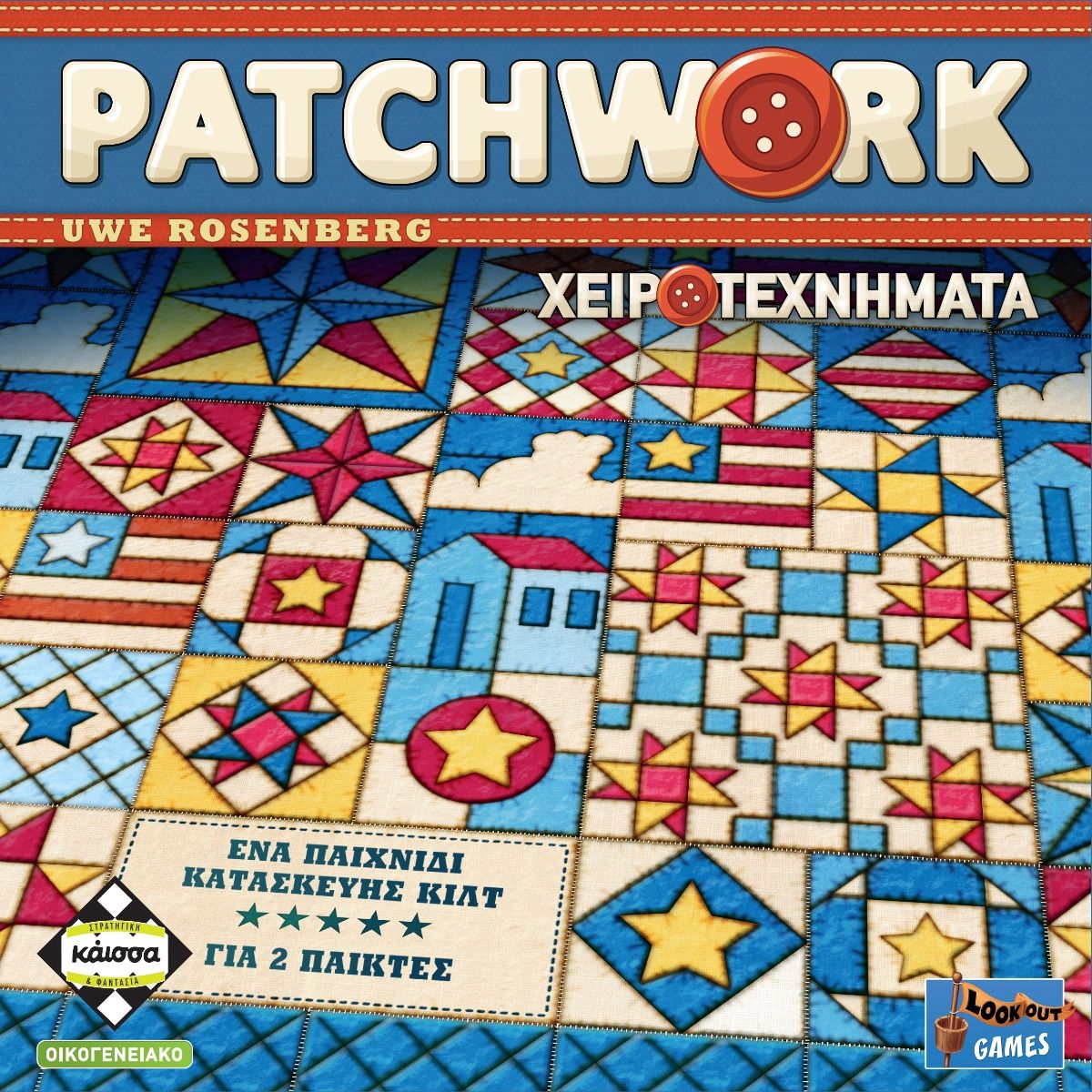
Patchwork Review
The Definitive Two-Player Puzzle — Twenty Years On, Still Unbeaten
Hook / First Impression
Open a copy of Patchwork and what you see looks almost nothing like a serious board game. There is a circular track of fabric patches, a small 9×9 personal quilt board, a fistful of wooden buttons, and a gentle grandmother-and-grandchild illustration on the box. It looks like a toy. Then you play your first game and discover that beneath the cozy aesthetic lives one of the most precisely designed two-player puzzles ever put in a box.
Uwe Rosenberg, best known for sprawling economic heavyweights like Agricola and A Feast for Kings, designed Patchwork as a distillation exercise: what is the absolute minimum needed to produce meaningful, interesting decisions for two players? The answer, it turns out, is a time track, a button economy, and Tetris-style pieces on a personal board. Every mechanic earns its place. There is no fat.
Overview
Patchwork is a two-player abstract puzzle game designed by Uwe Rosenberg and published by Lookout Games (distributed by Mayfair/Z-Man in North America). Players compete to build the most complete and button-rich quilt on their personal 9×9 board, buying fabric patches using time and buttons — and crucially, whoever spends less time on any given turn is always the active player, creating a constant tug-of-war of tempo and resource management.
| At a glance | |
|---|---|
| Designer | Uwe Rosenberg |
| Publisher | Lookout Games |
| Year | 2014 |
| Players | 2 only |
| Play time | 15–30 minutes |
| Age | 8+ |
| Weight | Light (BGG ~2.0/5) |
| Awards | Spiel des Jahres Recommended 2014 |
| Victory condition | Most buttons minus 2× uncovered squares |
Components & The Setting
The Setting: You and your opponent are quilters racing to complete a beautiful patchwork blanket before time runs out. The theme is unabashedly cozy — the artwork leans into warm fabrics, floral patterns, and pastoral illustration — but unlike many "theme as wallpaper" games, the thematic framing actually supports the mechanics. Spending time to cut and sew patches, earning buttons as you complete button-rich sections of your quilt, penalising gaps in your finished blanket — every rule maps directly onto what a quilter would experience. The theme does quiet, useful work.
Component quality is exceptional for a game at this price point. The 33 cardboard patch tiles are thick and satisfyingly tactile, printed with cheerful fabric patterns on one side and a neutral reverse. The 9×9 personal quilt boards have a matte finish that prevents tiles from sliding. The central time track — a circular ring of spaces on which both players advance their markers — is clear and well-printed. The wooden buttons (your currency) are genuinely charming: small, round, and realistically shaped rather than generic wooden discs. They give the game table presence disproportionate to its box size.
A small leather-patch token marks the starting position on the circular patch market; a 7×7 "special tile" rewards the first player to complete a 7×7 filled section within their quilt. The rulebook is four pages. Setup takes under two minutes. Everything about the component design communicates that this is a refined, purposeful product.
How to Play
The goal is to end the game with the highest score. Your score is your total button count minus two points for every empty square remaining on your 9×9 quilt board. Filling your board completely earns you nothing extra — but every empty square costs you two points at the end, so the cost of gaps is steep.
All 33 patch tiles are arranged face-up in a circle at the start of the game, with a small leather marker indicating the current "shop window." On your turn, you do one of two things:
- Buy a patch: Choose any of the three patches clockwise from the leather marker, pay its button cost, advance your time token forward by the patch's time cost, and place the patch on your quilt board in any legal orientation. The leather marker moves to fill the gap left by the patch you took.
- Pass: Advance your time token to one space ahead of your opponent's token and collect one button for each space you moved. Passing is never free — you always move at least one space — but it generates buttons and lets you stall for better patches.
The key rule: whoever has their time token furthest back on the track is always the active player. This means turns are not strictly alternating — one player might take three or four consecutive actions if they keep buying cheap (fast) patches, while their opponent advances further and further along the track. This asymmetric turn order is the engine that makes Patchwork work.
The game ends when both players reach the final space of the time track. Final scores are counted: total buttons on hand, minus two for each empty square on your board, plus the 7×7 tile bonus if you earned it.
Gameplay Feel
Pacing & Tension: Patchwork plays in a constant state of productive tension. Each turn, the decision of which patch to buy versus passing is never trivial — the three visible patches are almost always imperfect, offering trade-offs between button income, time cost, and spatial fit. The game has no downtime: because the active player is always the one furthest behind on the time track, you are always either playing or watching a single opponent's decision, never waiting through three other turns. The 20–30 minute play time feels exactly right — enough depth to satisfy, short enough that a rematch is always tempting.
Player Interaction is sharp and entirely spatial. You cannot directly interfere with your opponent's quilt, but the shared patch market is fiercely contested. The three-patch window means you regularly agonise over whether to take the patch that fits your board perfectly (knowing your opponent wants it too) or to take something cheaper and let them have it. Watching your opponent's board fills in — noticing what shapes they still need, tracking whether they're going for the 7×7 bonus — is as important as managing your own quilt.
Luck vs. Strategy Balance: The initial patch arrangement is randomised, but from that point the game is entirely deterministic. There is no card draw, no dice, no hidden information beyond your own plans. Everything on the table is visible to both players at all times. This makes Patchwork unusually skill-dense for its weight class. Experienced players win consistently over new ones, and the game rewards learning which patch shapes are flexible (fit many board configurations) versus which are "problem pieces" (large irregular shapes that become worthless late if you haven't planned for them).
Rule Overhead: Minimal. The turn structure is two options. Most new players are fully functional after a two-minute explanation. The time track trips people up once, the button income timing trips people up once, and then the game just flows. Patchwork is one of the easiest "real" strategy games to teach.
Mechanics Deep-Dive
The Time Track Economy
Patchwork's time track is the mechanism that separates it from every other tile-placement game. Standard turn-based games give each player equal turns; Patchwork gives you turns proportional to how little time you spend. A player who buys only fast, cheap patches can take four or five consecutive turns while their opponent wrestles with a single expensive, button-rich piece. This creates a continuous tempo war: fast patches let you take more turns but offer fewer buttons and awkward shapes; slow patches offer more buttons and better fits but hand the initiative to your opponent.
The pass action amplifies this. Passing generates buttons (one per space moved) and moves you back into contention, but it advances your token to just ahead of your opponent — meaning they get the next turn. Used aggressively, passing is a way to stall for the patch rotation to bring you a piece you need. Used badly, passing concedes the tempo lead and lets your opponent cherry-pick the market.
The Spatial Puzzle
Your 9×9 quilt board is 81 squares. The 33 patches, if all placed without overlap, cover far more than 81 squares — you will never buy all of them. The question is which patches to target, in which order, to fill your board as completely as possible while maximising button income. This is a genuine spatial optimisation problem under uncertainty, and it is what keeps experienced players thinking for the full game length despite the short rules.
Key spatial insights that separate good players from great ones:
- Corners are dangerous. Irregular patches left near the corners of your board create isolated empty pockets that become impossible to fill later. Prioritise closing off corners early, even with less desirable patches.
- Shape flexibility matters more than size. A large patch that fits your board perfectly today may create unfillable gaps tomorrow. Prefer patches that can be placed in multiple orientations without creating dead zones.
- Button income compounds. Patches with high button yield (two or three buttons printed on the tile) pay for themselves over multiple button income spaces. A three-button patch bought in the first third of the game can yield nine or twelve buttons before the game ends. In the late game the same patch may only pay out twice.
- The 7×7 bonus is a second game inside the game. The special tile for completing a 7×7 filled area rewards the first player to achieve it with a flat +7 points. Chasing this bonus requires a very different patch strategy — prioritising compact, square-friendly shapes over button income — and creates a meaningful fork in early-game decisions that experienced players navigate differently every session.
The Circular Market
The patch market is a circle of all 33 tiles, with a leather marker indicating the three "available" patches. When you take a patch, the marker moves to fill the gap. This means taking a patch doesn't just remove it from the game — it changes which three patches are available next. An experienced player considers not only what they want but what taking a specific patch reveals for their opponent. Deliberately leaving a patch in place to deny your opponent the choice of what lies just behind it is a subtle but real form of market manipulation.
Player Count Analysis
2 Players — The only option, and it's excellent. Patchwork is designed exclusively for two players and makes no apology for it. The time track mechanism only functions meaningfully at two: with three players the turn-order logic becomes complicated and the market pressure less precise. The game achieves everything it sets out to do at exactly this count — a tight, tense, fast puzzle that rewards skill and invites rematches.
This exclusivity makes it a uniquely powerful tool for couples, gaming pairs, and situations where you want a great two-player experience in under thirty minutes. It is our top recommendation for games that are both genuinely strategic and accessible to players with limited board game experience.
If you need something that scales beyond two players and scratches a similar spatial itch, Azul (2–4 players) and Cascadia (1–4 players) are the closest spiritual relatives at similar weight levels.
Replayability
Patchwork's replayability is high for its weight class, though it works differently than games with variable scoring cards or randomised boards. The patch circle is shuffled at the start of each game, creating a different starting arrangement — the three patches visible at game start are never the same, and the rotation order that follows changes every session. This produces meaningfully different strategic environments: some games are rich in early button-income patches; others are front-loaded with fast, cheap pieces that reward aggressive tempo play.
More importantly, the game rewards mastery in a way that keeps experienced players engaged across dozens of sessions. There is always more to learn: better patch sequencing, more precise board management, subtler market-denial timing. Games between two experienced players feel very different from games between two beginners, and the skill ceiling is higher than the light component count suggests.
After 40–50 games the base game begins to feel solved for very experienced players — the strongest patches and configurations become predictable enough that games turn on execution rather than discovery. The Patchwork Doodle and Patchwork Express variants offer fresh takes on the core mechanics for groups at this stage, as does the digital adaptation on iOS and Android.
Learning Curve
Ease of teaching: Exceptional. The rules fit on four pages and can be verbally explained in under three minutes. The time track mechanism is the one concept that requires a brief demonstration — showing new players that the active player is always whoever is furthest back on the track — but once seen it clicks immediately. Most players are making real decisions from the very first turn.
First-game experience: Almost universally positive. New players typically end their first game staring at a quilt filled with awkward gaps and immediately understand what they should have done differently — without needing to be told. This self-evident feedback loop is one of Patchwork's greatest design achievements. The game teaches you how to play it better by showing you the cost of your mistakes at the final scoring.
Age range: The 8+ rating is accurate. Children from around 8 understand the spatial puzzle and the button economy without adult guidance. The game's cozy aesthetic also helps — it does not intimidate younger players the way games with aggressive or complex art often do.
Who It's For
Couples and pairs: Patchwork is the single best answer to "what should we play just the two of us?" in our library. It is fast, genuinely competitive, accessible, beautiful, and leaves both players wanting a rematch. If you want one game that lives permanently on the coffee table for two-player evenings, this is it.
Puzzle lovers: If you enjoy spatial reasoning games — Tetris, Blokus, tangrams, any tile-fitting puzzle — Patchwork delivers that satisfaction within a competitive structure that adds stakes and interesting decisions.
Hobbyist gamers: An excellent light opener or closer for heavier game nights. It plays in 20 minutes and generates genuine tension despite the short rules. Experienced gamers who have never played Patchwork typically discover layers they didn't anticipate in the first session and reach for a rematch immediately.
Non-gamers: One of our best recommendations for introducing a reluctant or hesitant player to hobby games. The rules are minimal, the theme is welcoming, the components are charming, and the game never overwhelms. We have introduced Patchwork to non-gamers who now count it among their favourite games.
Comparisons: 7 Wonders Duel offers a richer two-player experience with more complexity and a longer play time. Jaipur provides faster, lighter two-player play but less spatial depth. Azul scales beyond two but scratches a similar pattern-building itch. Patchwork occupies a sweet spot of depth-to-time-ratio that none of these quite replicate.
Pros & Cons
What Patchwork does well:
- The most skill-dense game at its weight class — experienced players win consistently while newcomers still find it engaging and accessible.
- Near-zero downtime: because only one opponent is waiting, turns are always immediate and the game flows continuously.
- The time track mechanism is genuinely original — a turn structure that rewards spending fewer resources with more turns is elegant and memorable.
- Teaches itself through play: the gap penalty means new players see exactly what they should have done differently at the final scoring, making every game a learning experience.
- Compact, portable, and fast — plays in 20 minutes and fits in a bag without complaint.
- Charming components and artwork that give it table presence disproportionate to its box size.
- Scales perfectly to its target audience: two players, zero compromise.
Where Patchwork struggles:
- Two players only — there is no adaptation, official or otherwise, for groups of three or more.
- Very experienced players (40+ games) may find the base game somewhat solved; the patch value hierarchy becomes predictable and games turn on execution rather than discovery.
- No narrative or drama — Patchwork is a pure puzzle. Players who need a story, a theme that does heavy lifting, or player interaction beyond market denial may find it too austere.
- Button income tracking requires attention early on — new players occasionally forget to collect income at button spaces, which can swing the score enough to feel unfair once noticed.
Expansions & Ecosystem
Patchwork's ecosystem is small but thoughtfully designed. Rather than expanding the base game with additional complexity, Lookout Games has released accessible spin-offs that explore the same core mechanics in different formats.
Patchwork Express — Streamlined entry-level version ★★★☆☆
A faster, slightly simplified version of Patchwork designed for younger players and shorter sessions. The board is smaller (7×7), the patches fewer (21), and the play time drops to around 15 minutes. Button income is removed — patches cost only time, simplifying the economic layer considerably. The result is a clean puzzle that makes an excellent introduction for children aged 6 and up. For adults who have played the base game, Express feels thin; its main value is as a teaching tool or a faster variant for tight schedules.
Patchwork Doodle — Solo/multiplayer roll-and-write spin-off ★★★★☆
A roll-and-write game for 1–6 players (a significant departure from the base game's 2-player exclusivity) in which all players simultaneously draw the same rolled patch shape onto their personal score sheet. The tension of the original — fitting irregular shapes into a limited space — survives the transition to paper, and adding up to six players without increasing play time is a genuine achievement. The competitive element is reduced compared to the base game but the spatial puzzle is equally satisfying. An excellent travel version and the best option for groups larger than two who love the Patchwork concept.
| Version | Best For | Players | Rating |
|---|---|---|---|
| Patchwork | Definitive two-player experience | 2 | ★★★★★ |
| Patchwork Express | Children, ultra-casual | 2 | ★★★☆☆ |
| Patchwork Doodle | Groups, travel | 1–6 | ★★★★☆ |
Value for Money
Patchwork retails for approximately $25–$35 USD (€20–28 in Europe) — one of the most affordable games in the hobby for the quality of experience it delivers. The components are high quality, setup takes two minutes, play takes twenty, and the game survives hundreds of sessions without wear. The per-play cost is negligible within a month of purchase for any pair who plays regularly.
- Couples and pairs: Extraordinary value. No other game at this price point delivers this level of depth and replayability for exactly two players.
- Gift-givers: A safe and impressive gift. The box is small and inexpensive, but the game inside punches well above its weight — recipients who are new to hobby games consistently discover more than they expected.
- Hobbyist gamers: Worth owning even if your collection includes heavier titles. It fills a specific niche — a fast, skill-rewarding two-player option that teaches in minutes — that no other game covers as elegantly.
Accessibility
Color blindness: Patchwork handles this well. The patches are distinguished by shape and texture rather than color alone; the quilt boards are neutral grids; and the time track markers are distinguishable shapes (typically different colours, but the positions themselves carry all the relevant information). No significant barrier for players with color vision deficiency.
Language dependence: None. There is no text on any component during play. The rulebook requires reading once; after that the game runs entirely on iconography and spatial reasoning. Suitable for multilingual groups and players with limited literacy.
Cognitive accessibility: The rules are simple enough for most players with moderate cognitive load capacity. The two-option turn structure removes decision paralysis; the visible board states make all information transparent. Button income tracking is the one rule that requires active memory — players with working memory difficulties may benefit from a printed reminder card listing the button space locations. The game does not require reading, hidden information management, or complex multi-step calculations.
Physical accessibility: Patch tiles are cardboard and moderately large — easy to handle for most players. Button tokens are small; players with dexterity limitations may find handling individual buttons fiddly. Placing buttons in a bowl beside the board rather than the bag eliminates this issue. The quilt boards lie flat and require no sustained physical manipulation.
Age range: The 8+ rating is appropriate. Children from 7 engage with the spatial puzzle independently; the button economy becomes meaningful from around 8–9. The game's cozy theme makes it uniquely non-intimidating for children and older adults alike.
Verdict
Patchwork is a masterclass in design economy. Uwe Rosenberg built a game with fewer components than a deck of cards, a rule set that fits on four pages, and a play time of twenty minutes — and managed to include genuine strategic depth, a novel turn-order mechanism, meaningful economic decisions, and a spatial puzzle that rewards both first-time players and veterans across hundreds of sessions.
It does not do everything. It plays exactly two players. It has no narrative, no escalating drama, no variable powers. If your game nights require social interaction, diplomacy, or player elimination, Patchwork will feel too quiet. But for what it is — the definitive head-to-head two-player puzzle — it has been unbeaten for over a decade, and nothing in the hobby quite replaces it.
Buy it if: you want the best two-player game at any price point, or the perfect gift for a gaming pair of any experience level.
Skip it if: your game sessions always involve three or more players and you have no regular two-player gaming in your life.
Add Patchwork Doodle if: you love the core spatial puzzle but need it to scale beyond two players for larger groups or travel.
Score Breakdown
Love board game night? Explore our tools, score calculators, and strategy guides — everything you need to play better and have more fun.
Browse All Articles →