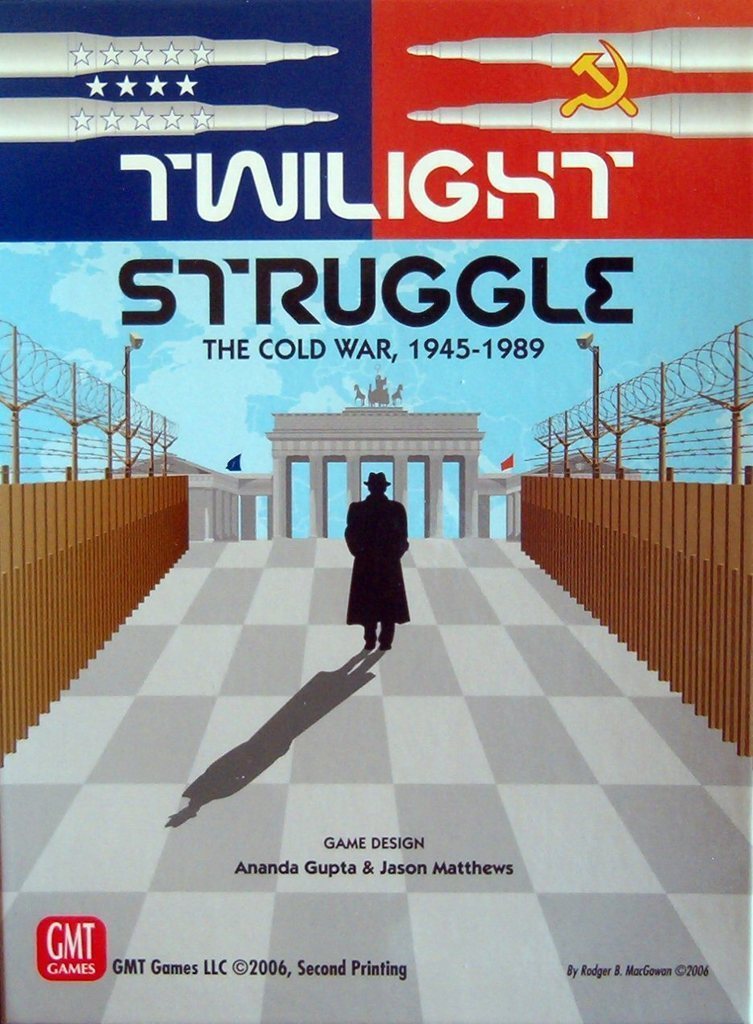
Twilight Struggle Review
The Cold War on Your Table — Forty-Five Years of Superpower Tension in Two to Three Hours
Hook / First Impression
For six years, Twilight Struggle sat at the top of BoardGameGeek's all-time rankings — the most-rated, most-reviewed, most-debated game in the hobby. It was finally displaced by Pandemic Legacy, then by Gloomhaven, then by Brass: Birmingham. It has never left the top twenty. That kind of staying power does not come from marketing or novelty. It comes from a design that is almost unreasonably good at doing one specific thing: putting two players inside the logic of the Cold War and making them feel the weight of every decision.
Designed by Ananda Gupta and Jason Matthews — two former CIA analysts, a detail that explains a great deal — and published by GMT Games in 2005, Twilight Struggle is a two-player card-driven wargame covering the global ideological competition between the United States and the Soviet Union from 1945 to 1989. One player takes the USA, one takes the USSR, and over ten turns the two superpowers manoeuvre for influence across the map of the world, each playing historical event cards that may benefit them, their opponent, or both — and always, always, managing the terrifying DEFCON track that measures how close the world is to nuclear war.
Overview
Twilight Struggle is a two-player card-driven strategy game covering the entire Cold War. Players alternate playing cards from their hand — each card representing a historical event, a policy instrument, or a covert operation — to place influence on a map of the world divided into regions: Europe, Asia, the Middle East, Africa, Central America, and South America. The player who controls the most strategically significant countries at the end of the game — or who triggers an automatic win condition — wins the Cold War.
| At a glance | |
|---|---|
| Designers | Ananda Gupta & Jason Matthews |
| Publisher | GMT Games |
| Year | 2005 (Deluxe Edition 2009) |
| Players | 2 only |
| Play time | 120–180 minutes |
| Age | 13+ |
| Weight | Heavy (BGG ~3.6/5) |
| Victory conditions | VP track (20 VP lead), DEFCON automatic loss, Europe control, or game end score |
Components & The Setting
The Setting: The game spans 1945 to 1989 in three eras — Early War (turns 1–3), Mid War (turns 4–7), and Late War (turns 8–10). Each era has its own card deck reflecting the historical events of the period. The Early War cards cover the Berlin Blockade, the Korean War, the Marshall Plan. The Mid War introduces the Non-Aligned Movement, the Vietnam War, and the Space Race. The Late War arrives with Solidarity, Glasnost, and the events that unravel the Soviet empire. The historical arc is not cosmetic — the game's balance and strategic options shift meaningfully between eras, and the cards you hold at any given moment tell you something about where the Cold War stands.
The Deluxe Edition (2009) is the version most players own and recommend. The main board is a large, handsome political map of the world with countries represented as nodes connected by lines — the Cold War's theatre of operations rendered as a strategic abstraction. Each country has a stability number (how hard it is to influence) and a battleground designation (indicating its strategic significance for end-of-turn scoring).
The card decks are the game's soul. 110 cards in total, divided by era, each bearing the name of a real historical event, an operations point value (1–4), and a text effect. Roughly half the cards in any deck are US-aligned and half USSR-aligned; drawing your opponent's cards is unavoidable and creates the game's central hand management dilemma.
Supporting components include influence markers in red (USSR) and blue (USA), a VP track running from −20 (Soviet victory) to +20 (American victory), a DEFCON track (5 = peaceful coexistence, 1 = nuclear war and immediate game end), a military operations track, and a space race track. The Deluxe Edition adds improved card stock and a sturdier board; the production quality is functional rather than premium but entirely adequate for a wargame publisher.
How to Play
Each turn begins with a Headline Phase: both players simultaneously select one card from their hand and place it face-down as their headline. Cards are then revealed and resolved in order of operations value (higher ops goes first). The headline is the turn's opening gambit — a declaration of intent that your opponent must now react to without having seen it when they chose their own.
After headlines, players take turns in the Action Rounds — six per turn in the Early War, rising to seven and then eight in later eras. On each action round, a player plays one card from their hand. Every card can be played in one of four ways:
- For Operations points: Use the card's ops value to place or remove influence markers on the map, attempt a coup in a country (remove opponent influence and potentially place your own, at cost to DEFCON), or conduct a realignment roll (attempt to reduce opponent influence using a dice-driven comparison of regional factors).
- For its Event: Trigger the card's historical event text. If it is your own faction's event, the effect benefits you. If it is your opponent's event, you still trigger it — playing the card for operations on an opponent's event card still fires the event.
- For the Space Race: Discard the card to the space race track for a potential bonus — removing a card from play entirely, which is sometimes the best use of a dangerous opponent card.
- As the China Card: A special card passed between players when played for ops, representing the strategic relationship with China and providing a powerful one-time bonus in Asia.
The map is divided into regions, each scored at specific points during the game by scoring cards. Scoring cards enter the draw deck and must be played when drawn — you cannot hold them. When a scoring card is played, the region it covers is evaluated: the player with more controlled battleground countries and total presence scores VP accordingly. Controlling all battlegrounds in a region while also having more influence overall is Domination; controlling every country is Control, worth more VP still.
The game ends when one player reaches a 20 VP lead, when DEFCON drops to 1 (the player who caused it loses immediately), when one player controls all European battleground countries, or at the end of Turn 10, when final scoring across all regions determines the winner.
Gameplay Feel
Pacing & Tension: Twilight Struggle plays in a state of controlled anxiety from the first turn to the last. The Early War establishes the board — both players racing to place influence in Europe, the Middle East, and Asia before scoring cards arrive. The Mid War expands the theatre and introduces the most powerful event cards; this is where games are won or lost through card management. The Late War escalates the VP consequences of every decision, and the appearance of late-game event cards like Wargames (which can be traded for an immediate victory if you are leading by 6+ VP) creates final-stretch drama that few other games can match.
Player Interaction: Total. There is no aspect of Twilight Struggle that does not involve your opponent. The map is a direct competition: influence you place is influence your opponent must overwrite. The events you fire directly harm them. The coups you attempt destabilise their positions. The scoring cards you hold determine when regions are evaluated — a player who can time a scoring card to fire when they are ahead scores the maximum. Every action is a move in a bilateral negotiation of force and counter-force.
Luck vs. Strategy Balance: Nuanced. The card draw introduces genuine variance — drawing your opponent's most powerful events in the same hand is punishing regardless of play quality — but experienced players consistently outperform new ones because managing bad draws is itself a skill. Coups and realignments involve dice, but the decision of when and where to attempt them is strategic. Over a full game, skill dominates luck; a single turn can be ruined by a poor draw, but a full match is very rarely decided by one.
Psychological Weight: Considerable and deliberate. The DEFCON track does not just end games — it shapes strategy across every turn. Military operations (coups) are required to avoid automatic VP loss, but performing coups lowers DEFCON and brings the world closer to nuclear war. Each player must walk this line continuously: enough military aggression to avoid the military operations penalty, but not so much that DEFCON drops to 1 and hands the game to your opponent. This managed tension is one of the most elegant mechanical expressions of its theme in the hobby.
Mechanics Deep-Dive
The Card-Driven System
Twilight Struggle belongs to the card-driven game (CDG) tradition pioneered by We the People (1994) and refined through Paths of Glory and Hannibal: Rome vs. Carthage. In a CDG, cards are simultaneously the source of actions (via their operations point values) and the source of historical events (via their text effects). The constraint that generates the system's depth is simple: you cannot pick and choose which aspects of a card to use. If you play a card for operations, the event fires. If it is your opponent's event, you have just done their work for them.
This means hand management in Twilight Struggle is not about accumulating powerful cards — it is about damage control. The US player who draws Vietnam Revolts has a card that, if played for its event, gives the USSR free influence across Southeast Asia. They can play it for its 2 ops value to place US influence somewhere, but the event fires anyway. They can burn it on the space race, but that costs an action round. They can hold it — but held cards must eventually be played, and the longer they hold it, the more likely a scoring card will arrive for a region where they cannot afford to be weak. Every bad card is a ticking clock.
The VP Track and the Asymmetric Starting Position
The VP track begins at 0 (neutral), runs to +20 (US automatic win) and -20 (USSR automatic win). The track does not move symmetrically — different events, scoring cards, and actions move it by different amounts, and the early game favours the USSR because the Soviet player has structural advantages in the Early War card deck. The US must play a careful defensive game in turns 1–3, limiting Soviet gains rather than pursuing ambitious ones, before the Mid War's more balanced card pool allows a more assertive approach.
This asymmetry is a design achievement. The two superpowers are not mirror images — the Soviet Union has historical advantages in Eastern Europe and Central Asia that the game encodes mechanically, and the United States has advantages in Western Europe, the Americas, and naval power. Learning to play each side requires understanding these structural differences, and playing the opposing side reveals how different the game feels even on the same map.
Scoring Cards and Tempo
Scoring cards are the game's tempo control mechanism. Each region has a scoring card that enters the deck at the start of a given era; when drawn, it must be played within the current hand (you cannot pass it to the next turn). The consequence is that both players must maintain viable positions across all regions simultaneously — you cannot simply concede Africa to focus on Europe, because the Africa scoring card may arrive at any moment. The player who draws a scoring card while ahead in that region wants to play it immediately; the player who draws it while behind may be forced to play it at significant VP cost or try to execute a last-minute coup to improve their position before scoring fires.
Timing scoring cards is among the game's highest-level skills. Players who understand which scoring cards are likely to appear in a given turn, and who position themselves to score multiple regions in a single sequence, gain enormous advantages. This tempo management — ensuring you score when ahead and delay when behind — is the strategic layer that distinguishes experienced players from new ones most clearly.
The Space Race
The space race track runs alongside the main game as a parallel competition. Cards can be discarded to the space race by rolling the required value; progress on the track grants one-time bonuses (drawing extra cards, peeking at the top of the deck, preventing opponent events) and recurring advantages to whoever is ahead. The space race is the game's release valve: it provides a legitimate use for dangerous opponent cards, removing them from the game at the cost of an action round. The decision of when to invest in the space race versus using that action round for map operations is a persistent strategic tension throughout the game.
The DEFCON Track
DEFCON begins at 5 and is lowered by coup attempts in battleground countries. At DEFCON 2, coups in Europe are prohibited — a historical echo of the Cuban Missile Crisis logic that nuclear powers cannot directly confront each other on the European central front. At DEFCON 1, the game ends and the player who caused the drop loses immediately. The DEFCON track creates the game's most distinctive strategic layer: the need to perform coups (to avoid the military operations VP penalty) but the catastrophic risk of driving DEFCON too low (instant loss). At DEFCON 2, a coup attempt in a European battleground ends the game. Every coup requires a calculation of DEFCON consequences, and the player who miscounts DEFCON — or who is baited by their opponent into a fatal coup — loses instantly, regardless of the map state.
Player Count Analysis
2 Players — The Only Option, and It Is Excellent. Twilight Struggle is a pure two-player game. There is no variant for three or four players, no solo mode in the base game, and no legitimate way to expand the player count without fundamentally altering what the game is. The two-player constraint is not a limitation — it is a design philosophy. The Cold War was a bilateral confrontation, and the game's mechanical DNA is built entirely around two players reading each other's intentions, managing shared information about the card pool, and making decisions under perfect adversarial scrutiny. Every mechanism assumes exactly two players.
Solo — Digital Only. The official digital adaptation of Twilight Struggle (available on Steam, iOS, and Android) includes an AI opponent and is broadly considered the best way to learn the game solo and practice between sessions. The AI is beatable but provides a reasonable approximation of basic play for learning purposes. There is no official physical solo mode; fan-made variants exist online but are not widely played.
Replayability
Twilight Struggle's replayability derives primarily from the variance in card distribution and the near-infinite strategic responses available within the game's framework. The card decks are shuffled within each era, meaning the sequence in which events fire is different every game. A game where Brush War arrives in turn 1 plays differently from one where it arrives in turn 3. A hand containing three scoring cards in the same turn creates a scramble to improve positions that a spread-out draw does not. No two games follow the same narrative arc.
The two asymmetric sides provide a second layer of replayability: mastering the US requires different strategic instincts than mastering the USSR, and most serious players prefer one side while acknowledging they should learn both. Switching sides for a full session reveals an entirely different strategic landscape on the same map. Combined with the card variance, most dedicated players log dozens of plays before feeling they have exhausted the game's strategic surface.
At the highest levels — reflected in the active competitive community around the digital adaptation — Twilight Struggle has metagame depth comparable to chess or Go in the sense that opening theory, mid-game responses, and specific card-sequence optimisations are studied and debated. The game rewards this level of analysis without requiring it, which is a rare design achievement.
Learning Curve
Ease of teaching: Moderate to steep, primarily because of card knowledge. The core rules of Twilight Struggle — play a card, use it for ops or event, place influence, track VP — are not complicated. What takes time is building familiarity with the 110 cards in the deck, because card knowledge changes every decision. A new player who does not know what Missile Envy does will be blindsided when their opponent plays it. A player who does not know that Star Wars only enters in the Late War will misevaluate their space race position. Card knowledge is the primary barrier to entry, and it takes five to eight sessions to develop sufficient familiarity to play without frequent rulebook lookups.
Rulebook quality: Good but dense. The GMT Games rulebook covers the rules clearly but the card FAQ section requires careful reading. The community has produced excellent player guides and card-by-card analysis documents (available on BoardGameGeek) that are more useful for new players than the rulebook alone. Watching a playthrough video before the first session is strongly recommended — seeing the card decisions in action teaches more than the rules text does.
First-game experience: Frequently humbling. New players typically discover, around turn three, that they have allowed a scoring card region to collapse while focused elsewhere, and the VP swing is severe. First games often end in Early War or Mid War blowouts as one player makes a decisive structural error. This is normal and instructive — the lessons of a lost first game stick precisely because the consequences were immediate. Most players who lose their first game badly want to play again immediately.
Teaching tip: Before the first game, walk through five or six of the most impactful Early War cards with your opponent — Duck and Cover, Five Year Plan, Socialist Governments, Marshall Plan, CIA Created. These are likely to appear in the first few turns and knowing what they do in advance prevents the paralysis of encountering them cold at the table. You do not need to teach all 110 cards — just enough that the first turn flows.
Who It's For
History enthusiasts: Twilight Struggle is the most historically literate mainstream board game ever published. The 110 cards cover real events — the Berlin Airlift, the Cuban Missile Crisis, the Nicaraguan Contras, Solidarity in Poland, Glasnost — and the game's outcome often produces narratives that echo real Cold War history with uncanny accuracy. Players with background knowledge in Cold War politics will find their understanding translating directly into strategic intuition. Even players who arrive without that knowledge leave having learned something about the period.
Two-player strategy enthusiasts: If you play chess or Go and want a game with more thematic texture and comparable strategic depth, Twilight Struggle occupies that niche almost uniquely. The decision trees are similarly deep, the information management is comparably demanding, and the reading-your-opponent skill transfers directly. The historical context adds a layer of meaning to strategic decisions that abstract games lack.
Players who enjoy card management under pressure: The core skill of Twilight Struggle — managing a hand of cards where every card is simultaneously useful and dangerous — is deeply satisfying when it clicks. Players who enjoy Agricola's feeding pressure, Arboretum's hand tension, or any game where the cards you hold are as much a problem to manage as a resource to use will find Twilight Struggle's card system one of the most elegant they have encountered.
Who it is not for: Players who want multiplayer experiences; anyone who dislikes the wargame aesthetic or significant theme; players who need games under 90 minutes; casual players who do not want to invest in learning a deep card pool; anyone who finds the Cold War's ideological history uncomfortable as gaming subject matter. For two-player strategy without the historical weight, 7 Wonders Duel delivers similar intensity in half the time. For historical depth with more players, Hegemony covers political economy at the table with three or four.
Pros & Cons
What Twilight Struggle does exceptionally well:
- The card-driven system creates a hand management dilemma that is unlike anything else in the hobby — every card is simultaneously a weapon and a liability, and the forced-choice architecture generates constant pressure without feeling arbitrary.
- The DEFCON track is a mechanical expression of nuclear deterrence logic that works thematically and strategically — it shapes every decision without ever feeling like a gimmick.
- Historical accuracy is genuinely integrated into the design: the events, their timing, their effects, and the game's asymmetric structure all reflect real Cold War dynamics rather than borrowing the theme as decoration.
- The game has among the highest skill ceilings of any hobby game. Experienced players consistently outperform new ones by a large margin, and the learning curve rewards continued investment over years, not just sessions.
- The two asymmetric sides provide meaningfully different strategic experiences on the same map — mastering both requires understanding the game from two entirely different structural positions.
- The digital adaptation extends the game's life significantly, providing an always-available opponent and an excellent platform for learning and practice between physical sessions.
Where Twilight Struggle struggles:
- The game is strictly two-player, which limits its utility for groups who cannot reliably find a dedicated second player willing to invest in learning it.
- Card knowledge is a significant entry barrier. New players will be surprised by events they have not yet memorised, and early games frequently feel less like strategy and more like discovering traps set by cards they did not know existed.
- The Early War heavily favours the Soviet player, which means first games where one player takes the USSR and the other takes the USA often end in Soviet wins that do not reflect the long-term balance of the game. First-session blowouts are discouraging without context.
- The production quality is serviceable but unexciting by modern standards. The Deluxe Edition boards and cards are adequate; they are not the beautiful objects that games like Wingspan or Everdell produce. The game's value is entirely in its design, not its components.
- Session length and mental intensity mean Twilight Struggle is not a light evening game. It demands full attention for two to three hours, and players who play it casually between other games tend not to develop the card knowledge necessary to enjoy it fully.
- The randomness of the card draw, while manageable at high skill levels, means there are genuinely unlucky games where a player draws three opponent scoring cards in one hand and the VP swing is catastrophic regardless of play quality.
Expansions & Ecosystem
Twilight Struggle has a deliberately minimal expansion ecosystem, reflecting GMT Games' philosophy of releasing expansions only when they add something structurally meaningful to the base game.
Turn Zero — Optional Early Cold War prologue scenario ★★★★☆
Turn Zero is an optional prologue scenario covering the 1944–1945 period before the base game begins — the Yalta Conference, the liberation of Europe, and the early positioning that defined the Cold War's opening posture. It adds a pre-game setup phase in which players deploy their initial influence through a structured bidding and placement system rather than the fixed starting positions of the base game. Turn Zero increases setup variance, gives experienced players more control over opening positions, and adds approximately 20–30 minutes to a full game. It is included in later printings of the Deluxe Edition.
Digital Adaptation — Steam, iOS, Android ★★★★★
The official digital adaptation is not an expansion but deserves mention as an essential part of the modern Twilight Struggle ecosystem. The digital version handles the rules automatically (reducing setup and enforcement overhead), includes an AI opponent, supports asynchronous online play, and has a card reference system that removes the memory barrier for new players. Many dedicated Twilight Struggle players log the majority of their games digitally. For anyone learning the game, the digital version is the most efficient path to competence.
| Product | Best For | Complexity Added | Rating | Priority |
|---|---|---|---|---|
| Turn Zero | Experienced players wanting opening variance | Low | ★★★★☆ | 🥇 After 10+ base game sessions |
| Digital Adaptation | Learning, practice, finding opponents | None | ★★★★★ | 🥇 Buy alongside the physical game |
Value for Money
Twilight Struggle Deluxe Edition retails for approximately $55–$65 USD (€45–55 in Europe), placing it in the mid-price range for a heavy strategy game. For a game that sustains genuine strategic depth across fifty or more sessions — and whose digital companion extends that depth indefinitely — the per-session cost is exceptionally low for dedicated players.
- Dedicated two-player gamers: Outstanding value. The game's skill ceiling is high enough that many players spend years without feeling they have fully mastered it. The combination of physical and digital play means sessions are available whenever a partner is willing, and the investment in card knowledge compounds across every session played.
- Players who primarily play in groups of three or four: Consider carefully. Twilight Struggle cannot be adapted for more than two players, so if your gaming group is primarily four-player, this game will be used for dedicated two-player evenings rather than regular group nights. It is worth owning if you have any consistent two-player gaming, but it should not be bought expecting it to replace group games.
- Used copies: The Deluxe Edition holds its value on the secondary market, and copies in good condition are regularly available. The cards are the most wear-prone component; inspect the card stock before buying used. GMT Games periodically restocks and offers their games through a P500 pre-order system, which is an alternative to retail for buyers willing to wait.
- Digital-first option: The digital adaptation costs approximately $15 USD and provides the full game experience with AI and online opponents. Players who are unsure whether the full physical game suits their group can learn the game digitally at low cost before committing to the physical edition.
Accessibility
Color blindness: The game uses red and blue as the primary faction colours for influence markers — a common colour pairing that is problematic for red-green colour blindness. The Deluxe Edition markers are clearly shaped differently as well as coloured (stars for US, hammers for USSR), which provides a secondary differentiator. Players with significant colour vision deficiency may still find distinguishing markers on a dense board challenging; labelling the cups used to hold spare markers can help.
Language dependence: Very high. Every card has event text that cannot be replaced by icons, the map has country names that must be read, and the rulebook is text-heavy. Twilight Struggle requires English proficiency (or availability in your language — it has been translated into several European languages) to play meaningfully. The digital version's card reference system reduces the in-play text burden somewhat.
Cognitive accessibility: Twilight Struggle is demanding. Card knowledge, map evaluation, VP tracking, DEFCON calculation, and hand management must all be maintained simultaneously. The decision space is deep rather than broad — there are rarely more than three or four meaningful actions available on any given turn — but evaluating those actions requires integrating many variables. The game is not suitable for players with significant cognitive limitations, though the structured turn sequence and clear action types (ops, event, space race, coup, realignment) are more accessible than they appear on first reading.
Physical accessibility: No dexterity or timing requirements. The physical components — placing and removing influence markers, shuffling cards — are standard. The board is large but static; players do not need to reach across it quickly. No timed elements in the physical game.
Age range: The 13+ rating is appropriate. The Cold War's ideological history — nuclear deterrence, proxy wars, covert operations, superpower coercion — is adult in character, though not graphic. Teenagers with strong interest in history or strategy games can engage meaningfully. The card knowledge barrier makes it more rewarding for older players who can maintain reference across multiple sessions.
Verdict
Twilight Struggle is one of the most accomplished game designs ever published. Gupta and Matthews built a system in which theme and mechanics are not merely aligned but inseparable — the card-driven hand management expresses the logic of Cold War ideology (you cannot simply discard the ideas you find inconvenient), the DEFCON track expresses the logic of nuclear deterrence (aggression is necessary but catastrophic if taken too far), and the map's structure expresses the logic of spheres of influence (peripheral countries matter because they aggregate into regional dominance). Every mechanism is doing work that no other mechanism could do as well.
Its constraints are real. Two players only, three hours, steep card knowledge barrier, and production quality that has aged relative to modern hobby standards. These are the reasons it no longer holds the BGG top spot. They are not reasons to avoid it.
Buy it if: you have a dedicated two-player gaming partner, an interest in Cold War history (or a willingness to develop one), and the patience to invest five sessions in learning the card pool. The game you encounter after that investment is one of the most satisfying strategic experiences the hobby has produced.
Skip it if: you primarily game in groups of three or more, want a game that teaches in under 30 minutes, or are put off by the wargame aesthetic and Cold War subject matter. 7 Wonders Duel provides excellent two-player tension at lower complexity; Hegemony delivers political strategy for the full table.
Start with the digital version if you are unsure — $15 and ten games against the AI will tell you whether this is your kind of game far more effectively than a rulebook ever will.
Score Breakdown
Love deep strategy games? Explore our reviews, score calculators, and strategy guides — everything you need to play better and have more fun at game night.
Browse All Reviews →