
Spider Solitaire Strategy Guide
Rules, History, Suit Modes, and the Tactics That Actually Win
Why Spider Solitaire Is the Most Strategic Solitaire Variant
Spider Solitaire has a reputation as a casual time-killer, the game that lived in the corner of every Windows desktop for decades. That reputation is both deserved and deeply misleading. Yes, the 1-suit version is something you can play half-asleep. But push it to 4 suits — two full decks, all four suits in play — and you're sitting in front of one of the most strategically demanding single-player card games ever designed.
Of the dozens of Solitaire variants that exist, Spider stands apart. Where Klondike is largely reactive — you move what the draw pile gives you — Spider demands a proactive, planned approach from the very first card. The entire deck is dealt face-down across ten columns from the start. You can see the top card of each column. The decisions you make with those visible cards determine whether the hidden cards beneath ever come to light.
The gap between beginner and expert is not luck. It is planning, discipline, and a set of principles that, once learned, change how you see the entire board. Whether you're playing the classic Windows version, a mobile app, or the browser version at Game Night Pro, the principles below apply without exception.
A Brief History of Spider Solitaire
Solitaire card games have roots stretching back to 18th-century Northern Europe, where they were known as Patience games and played almost exclusively by the aristocracy as exercises in concentration and solitude. The broader Patience family — Klondike, FreeCell, and dozens of others — spread through Europe and eventually into popular print culture during the 19th century, when puzzle and game books became widely published.
Spider Solitaire itself is believed to have emerged in the early 20th century, though its precise origins are disputed. The name derives from the spider's eight legs — a reference to the eight foundation piles that a player must complete to win the game. Unlike Klondike, where cards are built onto existing foundations as you play, Spider requires completing a full suit sequence (King down to Ace) directly within the tableau columns before it is swept off the board — a structural difference that completely changes the strategy.
The game entered mass culture in 1998, when Microsoft included it in Windows 98 Plus! and then bundled it as a default application in Windows XP. That version — designed by Oberon Games — introduced the now-standard three difficulty modes (1 suit, 2 suits, 4 suits) and is singlehandedly responsible for introducing Spider to hundreds of millions of players worldwide. For most people alive today, Spider Solitaire is the Windows XP version: green felt, that satisfying cascade animation, and the crushing loss screen.
Microsoft removed the built-in Solitaire suite in Windows 8, replacing it with a separately downloadable Microsoft Solitaire Collection in 2012. The Collection reintroduced Spider alongside Klondike, FreeCell, TriPeaks, and Pyramid — and added daily challenges, events, and statistics tracking, transforming what had been a solitary pastime into something approaching a casual competitive game.
How Spider Actually Works: The Core Rules
Spider Solitaire is played with two standard 52-card decks (104 cards total). At the start, all 104 cards are dealt face-down into ten tableau columns — four columns of six cards and six columns of five cards. The top card of each column is turned face-up. Five stock piles of ten cards each are held in reserve. The goal: build eight complete descending sequences from King (high) down to Ace (low), each in a single suit, and clear them all from the board.
Moving cards: You can move any face-up card onto another face-up card of the next higher rank — a 7 onto an 8, a Queen onto a King. Any suit can go onto any other suit, but only a same-suit sequence can be moved as a group. A mixed-suit sequence (red 7 on black 8) is legal to build, but that stack is locked in place — you can only move its top card individually, not the whole stack as a unit. This single rule is the entire engine of Spider's difficulty.
Empty columns: When a column is completely cleared, it becomes a workspace. Any card or valid same-suit sequence may be moved into it. Managing empty columns is the single most important strategic axis in Spider.
The stockpile: When you want fresh cards, deal from the stock — one card face-up to each of the ten columns simultaneously. You cannot deal from the stockpile if any column is currently empty. There are five deals available in a standard game (50 cards ÷ 10 columns).
| Element | Detail |
|---|---|
| Decks used | 2 standard 52-card decks (104 cards total) |
| Tableau columns | 10 |
| Initial deal | 54 cards (6 to first 4 columns, 5 to remaining 6) |
| Stockpile | 50 cards, dealt 10 at a time (5 possible deals) |
| Goal | Complete 8 same-suit sequences (King → Ace) |
| Stack movement | Only same-suit stacks move as a unit |
The Game Night Pro Spider Solitaire features all three modes, drag-and-drop card movement, an undo system, hints, and a live score tracker. Whether you're learning the basics on 1-Suit or fighting through a 4-Suit endgame, the tools are there to support you.
The Three Difficulty Modes
Spider Solitaire's defining innovation is its three-tier difficulty system. The same rules apply across all three, but the number of suits in play changes everything about how you must think and plan. These are not merely difficulty settings — they are fundamentally different games.
Both decks consist entirely of Spades. Since every card shares a suit, any face-up sequence can be moved as a single unit. Empty columns appear frequently, and completing sequences is almost automatic once you learn the basic flow. Win rates above 90% are achievable with disciplined play. Use this mode to internalise the four core principles before adding suit complexity.
The 104 cards consist of two suits — Spades and Hearts. Mixed-suit sequences now appear naturally, and the constraint on moving multi-card stacks starts to bite. Your primary new challenge is sorting: separating interleaved suits into same-suit columns. Win rates of 60–75% are realistic for players who apply the principles consistently.
All four suits are in play across both decks. Mixed-suit tangles appear almost immediately, empty columns are precious and rare, and the board can lock up completely after a handful of undisciplined moves. Expert players estimate a genuinely winnable deal exists in roughly 50–60% of games. Recognising a lost position early is itself a strategic skill.
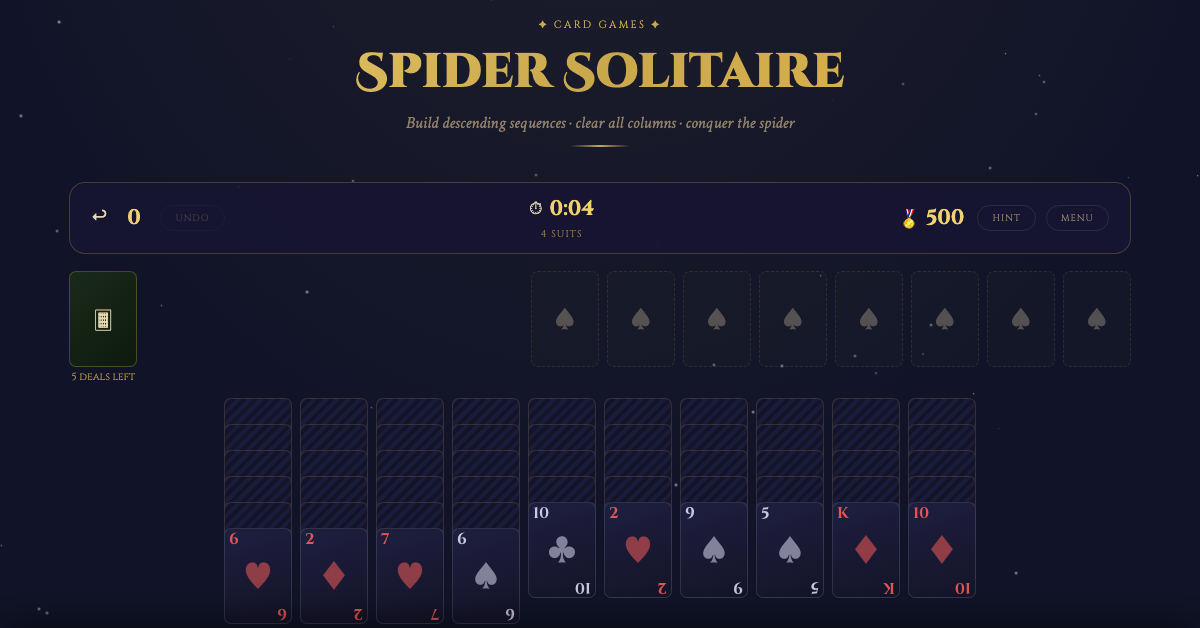
Principle 1 — Expose Hidden Cards First
Every face-down card is a locked door. Until it's flipped, you have no information about it and no choices involving it. The primary objective of every move you make in the early and mid-game is to expose as many face-down cards as possible.
This means prioritising moves that reduce the number of face-down cards in a column over moves that seem more "elegant" or that build longer sequences. A King-high sequence that buries eight face-down cards under it is worse than a scattered tableau where every column has fresh face-up cards to work with.
Practical application: Look at each column and count how many face-down cards sit beneath the top face-up card. Columns with many face-down cards are your priority. Any move that lets you flip one of those buried cards advances your game. When two moves seem equal in value, take the one that reveals a card in the deeper column.
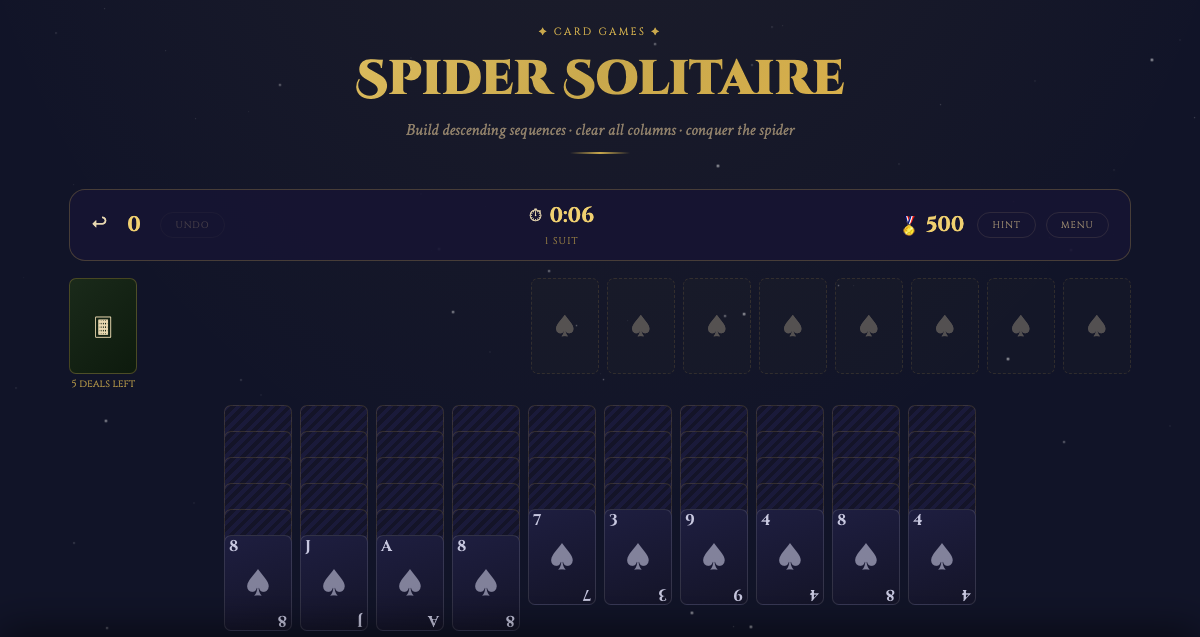
Above: the opening position of a 1-Suit game. Most cards are face-down. The immediate goal is not to build the most beautiful sequences — it's to flip those hidden cards. Each revealed card is a new option; each option increases your chance of finding sequences that clear columns.
Principle 2 — Empty Columns Are Your Most Valuable Resource
An empty column in Spider Solitaire is not a void — it's a workspace. The number of empty columns you control directly determines how many cards you can rearrange in a single turn. Without empty columns, you cannot move same-suit stacks of more than one card anywhere useful. With three empty columns, you can perform complex multi-step reorganisations that would otherwise be impossible.
Why empty columns matter so much: To move a same-suit sequence of length N, you need at least N−1 empty columns (or a combination of empty columns and other columns that can receive partial stacks). To move a 7-card King-to-7 sequence from one column to another, you need six temporary parking spaces. Without those, the sequence is stranded wherever it sits.
How to earn empty columns: Clear a column by building a complete same-suit sequence and removing it, or by consolidating all remaining cards onto other columns. The latter is more common in mid-game: if a column has only two or three face-up cards of compatible rank, you might be able to place them elsewhere and claim the empty space.
How to protect empty columns: Once you have an empty column, resist the urge to fill it immediately. An empty column filled with a King is only useful if that King is part of a plan — building a complete sequence toward completion. A King placed "just because" uses up a space that could have served three or four rearrangements. When you do need to fill one, prioritise placing a King — Kings are the only cards that can legitimately anchor a new column.
Principle 3 — Prefer Same-Suit Sequences Over Mixed Ones
This is the most commonly ignored principle among intermediate players, and it's where the most winnable games are lost. Any time you have a choice between building a same-suit sequence and a mixed-suit sequence of equal length, always choose same-suit.
A mixed-suit sequence looks like progress — you've built a 6-5-4 run, you've cleared some space, you feel good. But that run can only be moved one card at a time. It ties up cards that cannot travel together and contributes nothing toward a completion. Same-suit sequences, by contrast, are mobile units that you can shift as a group to wherever they're needed.
The compounding cost of mixed sequences: A mixed sequence of five cards requires four single-card moves to relocate. Four single-card moves consume four turns and require at least four empty column slots. A same-suit sequence of five cards requires one group move and one empty column. As the game progresses and columns deepen, this difference becomes the difference between winning and losing.
In 1-Suit mode, same-suit sequencing is trivially achievable — every card is a Spade, so every sequence is automatically same-suit. In 2-Suit and 4-Suit, you must actively plan to avoid mixed sequences. Before placing a card, ask: "Does this create or extend a same-suit run, or does it create a mixed block I'll have to break apart later?" When a mixed build is unavoidable, start as high as possible — a mixed sequence beginning with a 9, 8, 7 is manageable; one starting with a 3, 2, Ace is catastrophic, since Aces cannot be built upon at all.
Principle 4 — Delay Dealing from Stock as Long as Possible
Each stock deal drops ten cards onto an already-complex tableau — one per column, regardless of what's there. A stock deal onto a nearly-complete column can bury progress. A stock deal when you have no empty columns shrinks your manoeuvring room immediately. Dealing is a resource, and like all resources, it's better to spend it when you know what you're buying.
Before dealing, ask three questions:
- Have I exhausted all useful moves in the current position? If any face-up cards can extend a same-suit sequence or reveal a hidden card, make those moves first.
- Do I have at least one empty column? Dealing into a zero-empty-column position gives you ten new cards you almost certainly cannot manoeuvre effectively.
- Is there a sequence close to completion that a deal might help? If you're two cards away from a King-to-Ace run, a deal might provide exactly what you need — or it might bury the column you need to access. Know the risk.
The best time to deal is when you've genuinely exhausted the position — no useful same-suit moves, no hidden cards to expose, no columns to consolidate — and you have at least one or two empty columns as buffer. Rushing to deal earlier forfeits the information advantage that careful play builds up.
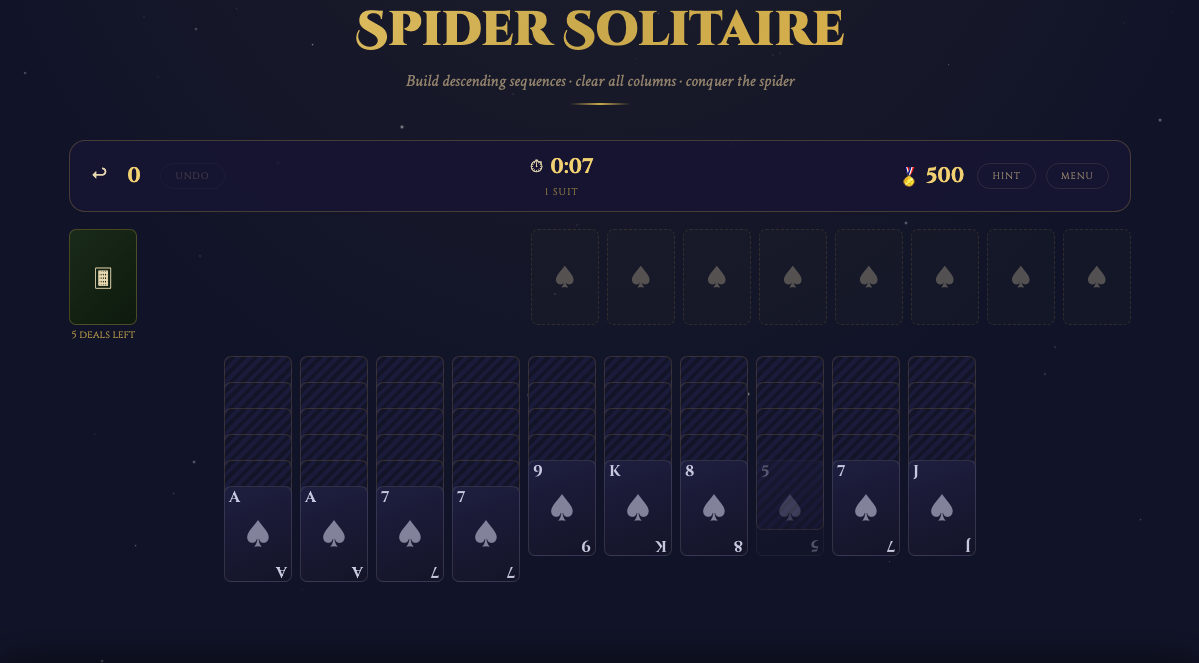
Above: a mid-game 1-Suit position. The stock still has deals remaining. Before clicking it, identify every face-up card that can be moved — any move that extends a sequence or frees a hidden card. Only once the position is truly static should the stock be consulted.
Mid-Game: Reading the Board and Choosing Your Target
Once the opening phase is complete (all initial face-down cards exposed, first deal possibly used), Spider Solitaire transitions into a mid-game planning problem. You have information — you can see most of the remaining cards — and you need to choose which sequence to complete first.
Target the most advanced sequence: Look for a suit where you've already built a partial same-suit run of six or more cards. Completing that sequence before it gets disrupted by a stock deal is often the highest-value goal. A complete sequence removed from the tableau opens one or more columns and gives you points and momentum.
Track "blockers": A blocker is a card of the wrong suit sitting on top of a card you need. If a red 7 is sitting on the black 8 you need to extend your same-suit Spade run, that red 7 must move first. Where can it go? Does moving it create a new same-suit opportunity or just move the problem? Thinking one or two moves ahead — rather than reacting to each position in isolation — is what separates mid-game competence from endgame victory.
Consolidate before dealing: Before any stock deal, spend time consolidating short columns. A column with two or three face-up cards that can be absorbed into other columns frees up space that the stock deal would otherwise eliminate. Post-deal, that space is gone; pre-deal, it's yours to use.
Advanced Tactics
Once the four core principles are internalised, these tactics represent the next level of Spider play — the decisions that separate players who win sometimes from players who win consistently.
Think three moves ahead. Before executing any move, ask: does this open a path, or close one? Does moving this card reveal the card beneath it? Does it free a column? Does it create a same-suit sequence that can move as a unit? If the honest answer is "none of the above — I'm just building a longer sequence," that move is almost certainly a trap. The board will reward moves that open possibilities and punish moves that feel productive but consolidate your chains.
Never move a card just because you can. In Spider, a legal move and a good move are very different things. Move a card only because doing so advances at least one of the four core principles. This discipline is the single biggest lever between losing repeatedly and winning consistently.
Use the undo button as a tool, not a crutch. The undo function is not cheating — it is a learning instrument. If you are genuinely uncertain whether a move will help or hurt, make it, observe the consequences, and undo it if the result is worse than the starting position. Over time, this experimentation trains your ability to visualise three moves ahead without physically testing them. The goal is to need undo less and less — not to reverse every bad result without understanding why it was bad.
Know when to restart. Some deals, particularly in 4-suit, reach a state of genuine deadlock — not because you made a bad move, but because the card distribution makes completion impossible regardless of play. Learning to recognise that state quickly — and restart rather than grinding through it — preserves your time and your pattern-recognition instincts. Don't treat a restart as failure; treat it as efficiency.
The Spider Solitaire Tactical Checklist
Apply these checks in order before each move, and before each stock deal. Internalising this sequence converts reactive play into deliberate strategy.
- Can I complete a sequence right now? If a King-to-Ace same-suit run exists or is one move from existing, complete it immediately. Sequences in hand are worth more than sequences in planning.
- Can I expose a hidden card? Any move that flips a face-down card is high value. Prioritise columns with more hidden cards.
- Can I extend a same-suit sequence? Same-suit extensions move you toward completion without creating future liabilities. Take them before mixed placements.
- Can I create or expand an empty column? A column with one or two face-up cards that can be absorbed elsewhere is worth consolidating even if the placement isn't "pretty."
- Am I avoiding mixed sequences? Before any placement, confirm whether it builds a same-suit run or creates a mixed block. If mixed, is there a same-suit alternative, even a less obvious one?
- Is the position truly static? Only deal from stock when all of the above checks come up empty — no useful moves remain. Premature dealing wastes the stock's potential.
- After dealing, what changed? Immediately after a deal, scan all ten new top cards. Some will extend existing sequences. Some will open new options. Process the new position fully before making a reflexive first move.
A Concrete Mid-Game Scenario
It's a 4-suit game, roughly fifteen moves in. The board shows ten columns: eight with a mix of face-down and face-up cards, one empty column, and one column with a nearly complete Spades sequence — only the King of Spades is missing, buried two face-down cards deep in column four.
The temptation is to deal from the stockpile, hoping the King of Spades surfaces. Don't. Instead: use the empty column to temporarily move the top face-up cards off column four, revealing the face-down cards beneath. Each revealed card is new information — and potentially the King you need, or a card that unlocks another sequence elsewhere. You've spent the empty column, yes, but you've gained knowledge and possibly the winning card without triggering a deal.
If the King doesn't appear, you can now assess: is the board truly exhausted? Only then deal — with a clearer picture of where your important cards actually are. This is Spider Solitaire at its sharpest: patience, information gathering, and resource conservation working together against the temptation to act.
The Mistakes That Lose Winnable Games
These are the patterns that consistently turn solvable positions into dead ends. Recognising them in your own play is the fastest path to improvement.
- Filling empty columns reflexively: The moment a column clears, placing the first available King into it. Unless that King is part of a specific sequence plan, the empty column is more valuable than the placed card.
- Building long mixed sequences early: A 7-card mixed run looks impressive but locks up seven cards that cannot travel together. You've created a monument, not a strategy.
- Dealing too early: Clicking the stock because the position "feels stuck" when careful analysis would find moves. The stock pile is finite — five deals, then nothing. Every premature deal narrows your future options.
- Ignoring depth disparity: Focusing on the columns that look tidy while ignoring columns with six or seven face-down cards underneath. Those buried columns are your biggest constraint and deserve the most attention.
- Burying low cards under high stacks: Placing a high card on top of a column that contains a low card deeper down blocks that low card for the rest of the game. Always be aware of what lies beneath before you add to a stack.
- Completing sequences at the wrong time: Removing a sequence when doing so would strand other cards is sometimes correct — but often it's better to hold it in place, use it as a stepping-stone for other reorganisations, and remove it when clearing it also clears an entire column.
- Neglecting the hint system: When genuinely stuck, the hint reveals a legal move. Even if you don't follow it exactly, it confirms the position isn't as locked as it appears and points toward areas of the board with available actions.
Quick-Reference Checklist Before Every Move
Run through this before placing any card — especially useful when learning or after a stockpile deal scrambles the board:
- Does this reveal a face-down card? If yes, it's almost certainly worth doing.
- Does this create or protect an empty column? If yes, prioritise it.
- Is this a same-suit move? If yes, prefer it over a mixed-suit alternative.
- What is buried beneath the card I'm moving onto? Will this block an important reveal?
- Am I three moves from a column clear? If yes, focus all resources there.
- Have I genuinely exhausted all options? Only if the honest answer is yes should you deal from the stockpile.
Spider Solitaire as a Shared or Competitive Experience
Spider is primarily a solo game, but it works surprisingly well in group settings — particularly as a teaching exercise or a relaxed competitive format.
Collaborative solving: One player manages the mouse while others call out moves. The constraint: every suggested move must come with a reason. "Move the 7 there because it extends the Spades sequence and flips a hidden card" is valid. "Move the 7 there because it fits" is not. Requiring articulation catches errors before they're made and teaches planning vocabulary to all players simultaneously.
Parallel speed run: Two players open 1-Suit games simultaneously on separate devices. First to remove all eight sequences wins. The time pressure changes the psychology — you start thinking faster, accepting slightly suboptimal placements to keep the pace. Comparing strategies afterwards reveals approaches neither player would have found alone.
Mode ladder: Start a group session with everyone on 1-Suit. Anyone who completes it moves to 2-Suit next session. Anyone who completes 2-Suit moves to 4-Suit. The ladder creates friendly progression and gives less experienced players a winnable goal while veterans face a genuine challenge.
Analysis mode: After a completed or failed game, use undo to walk back to a key decision point and explore the alternative path. This post-game analysis habit — "what if I'd done X instead of Y at that point?" — is the fastest way to build deep pattern recognition without requiring additional complete games.
Where to Play
Game Night Pro hosts a free browser-based Spider Solitaire with all three suit modes, drag-and-drop card movement, a full undo history, hints, and live score tracking. No account required, no download, works on any device. Start with 1-Suit to build your column management instincts, then climb to 2-Suit and 4-Suit as the principles become second nature.
Ready to put this into practice? Start with a 1-Suit game and focus exclusively on the core principles — reveal cards, protect empty columns, and never make a move you can't justify. Once those habits are automatic, move to 2-Suit. The 4-Suit board will wait for you.
Play Spider Solitaire →